Best Compact Treadmill For Apartment: Top Space-Saving Picks
The best compact treadmill for apartment living is quiet, foldable, stable, and easy to store after every workout.
Living in an apartment can make exercise hard. The gym may be far away, the weather may be poor, and a large treadmill can fill your room fast. A compact walking pad solves that problem by turning a small corner, home office, or bedroom into a simple workout space. I tested these options by looking at size, noise, storage, controls, incline, speed, and daily comfort. This guide will help you find the best compact treadmill for apartment use without wasting space or money.
Quiet Walking Pad for Small Apartments

This walking pad is made for people who need a small treadmill for home, work, or an apartment. Its slim design can fit under a desk, sofa, or bed in many rooms. The remote control lets you start, stop, and change your pace without reaching toward the motor. That simple layout makes it useful for short walks during a busy day.
The flat frame should appeal to users who want easy storage rather than a full gym-style machine. It is best suited to walking and light movement, not hard running or sprint work. The quiet design may also help in apartments where floor noise matters. Before buying, I suggest measuring both your open workout area and your storage spot.
Pros:
- Small footprint for apartments and home offices
- Remote control makes speed changes simple
- Flat shape supports under-bed storage
- Useful for work breaks and daily walking
- Light design is easier to move than a large treadmill
- Quiet operation is better for shared walls
Cons:
- Flat walking-pad design may not suit serious runners
- No raised handlebar for users who want extra support
- Small frames can feel short for very tall users
Foldable Treadmill With Handlebar
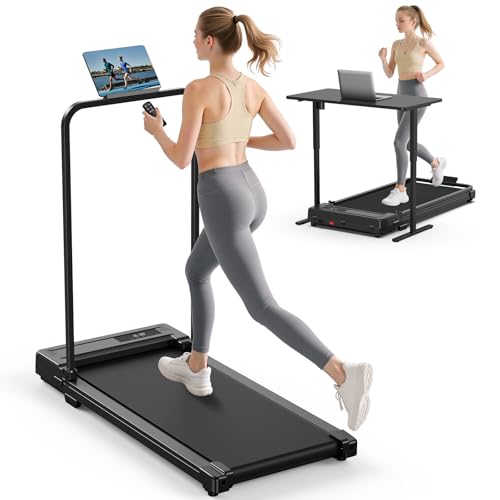
This compact folding treadmill adds a handlebar to the usual walking-pad format. That change matters if you prefer a more familiar treadmill feel or want a place to hold while stepping on and off. The bar can also make the machine feel more secure during faster walking. Its folding design helps reduce the space it needs when not in use.
The portable frame suits apartments, guest rooms, and small office spaces. It can work well for walking while watching a show, taking a short cardio break, or building a daily step habit. The handlebar does add some height, so I would not store it in a very low space without checking the folded dimensions. It is a practical middle ground between a flat walking pad and a full treadmill.
Pros:
- Folding frame helps save floor space
- Handlebar gives a more secure workout feel
- Portable design suits small homes
- Good choice for walking and light cardio
- Can be easier to mount than a handle-free pad
- Works in a home office or bedroom
Cons:
- Handlebar may limit under-bed storage
- Not the best choice for intense running
- Users must check folded height before buying
18% Incline Treadmill With Handles

This model stands out because it combines a compact folding frame with an 18% incline. Incline walking can raise the challenge without forcing you to run fast. It may help users build a stronger workout in less time, especially when apartment space limits longer exercise sessions. The three LED screens are designed to make key workout details easier to view.
The listed 350-pound capacity gives this treadmill a broader user range than many light walking pads. Shock absorbers may also help make each step feel less harsh, although the floor beneath the machine still affects sound and comfort. I like this option for users who want more than casual flat walking. It is still important to leave clearance around the treadmill and use a mat on hard floors.
Pros:
- 18% incline creates a demanding walking workout
- 350-pound listed capacity suits many body types
- Folding design helps with apartment storage
- Handlebars provide added balance and control
- Shock absorbers may improve step comfort
- Three LED screens make workout data easy to check
Cons:
- Incline can increase noise and floor vibration
- Heavier features may reduce portability
- Needs more open space than a flat walking pad
Compact Folding Treadmill With 6.2 MPH Speed

This folding treadmill covers a useful speed range from 0.6 to 6.2 MPH. That range allows slow walking, brisk walking, and some light jogging for users who feel comfortable on a compact deck. The handlebar gives the machine a standard treadmill shape while keeping the frame suitable for smaller rooms. Its quiet, lightweight design is aimed at people who want exercise without a large permanent setup.
I see this as a flexible option for couples or families with different walking habits. One person can use it for gentle movement, while another can raise the speed for a short jog. Still, a compact deck gives you less room than a commercial treadmill, so users should keep their eyes forward and stay centered. A floor mat can protect the apartment surface and reduce the sharp sound of foot strikes.
Pros:
- Speed range supports slow walking through light jogging
- Folding frame suits small rooms
- Handlebar adds confidence during movement
- Lightweight body is easier to shift around
- Quiet operation may be better for apartment life
- Useful for more than just under-desk walking
Cons:
- Compact deck may feel tight for long-stride users
- Light frames can move if placed on a slick floor
- Not intended to replace a full-size running treadmill
Walking Pad With 8% Incline and Handlebar

This walking pad gives apartment users a useful 8% incline without moving to a large gym machine. Incline walking can make a short workout feel more active and can add variety to a daily step plan. The handlebar helps users feel more stable when the deck rises. It also gives the treadmill a more traditional look than a flat pad.
The design should work well for people who want a modest challenge but do not need extreme hill training. It may fit a bedroom, den, or small living room when folded or stored upright. Incline models usually need extra care because the raised deck can change how the treadmill sits on the floor. I recommend checking the floor level and using slow speeds until you learn the machine.
Pros:
- 8% incline adds challenge to normal walks
- Handlebar improves balance and comfort
- More engaging than a fully flat walking pad
- Suitable for small home workout areas
- Good fit for users who want walking, not sprinting
- Compact format saves room compared with gym treadmills
Cons:
- Incline can increase power and sound needs
- May be less easy to slide under low furniture
- Small deck may not suit tall users
HOELLL 5% Incline Walking Pad

The HOELLL walking pad uses a 5% incline, which is a gentle step above flat walking. That small rise can make everyday movement feel less dull without creating a very steep climb. It is a strong match for a home office because it can support short walking sessions between calls or desk tasks. The compact build also helps conserve valuable apartment floor space.
I would choose this type of treadmill for a beginner who wants a simple way to add movement. A moderate incline can offer variety while remaining easier to manage than an aggressive hill setting. As with any under-desk treadmill, users should avoid typing while moving quickly and should keep the remote close. The best results come from regular use, not from pushing too hard on the first day.
Pros:
- Gentle 5% incline suits beginners
- Good fit for home office walking
- Compact size works in limited rooms
- Incline adds variety to daily steps
- Simple design may feel less intimidating
- Useful for short, frequent exercise breaks
Cons:
- Lower incline may not satisfy advanced users
- Under-desk use needs careful speed control
- Small walking decks require steady positioning
Walking Pad With 12% Auto Incline

This walking pad brings a 12% automatic incline to a compact treadmill design. An automatic incline can make it easier to change the workout without stopping to adjust the deck by hand. That feature is useful when you want flat recovery periods and steeper walking intervals. The black finish also gives it a clean look that can blend into a living room or office.
This model is better for users who view walking as real cardio rather than simple step tracking. A 12% grade can feel demanding, so beginners should start at a low speed and use short sessions. The machine may need more clearance than a flat pad, especially when the deck moves through its incline range. If your apartment has downstairs neighbors, use a thick treadmill mat and walk smoothly.
Pros:
- 12% auto incline adds strong workout variety
- Automatic adjustment saves time between intervals
- Compact design suits apartment fitness spaces
- Good option for users seeking harder walks
- Clean black finish fits many rooms
- Can support progressive walking workouts
Cons:
- Steeper incline may feel too hard for new users
- Moving incline parts need extra clearance
- Incline workouts may create more vibration
Compact Walking Pad With Incline Handle

This portable treadmill is built for home users who want an incline and a handlebar in a small package. The handle can help with balance during setup, stepping on, and faster walking. The incline adds a little more work than a flat walking pad, which helps keep routine walks fresh. Its portable design is helpful when the treadmill must share space with furniture.
I think it fits users who want a basic apartment treadmill but do not need a large console. It can serve as a backup for rainy days, a tool for daily steps, or a gentle cardio machine. The lack of a large frame makes it easier to store, but it also means the display and deck may be more limited than those on a premium model. Measure your stride and storage area before placing an order.
Pros:
- Portable shape suits small apartments
- Incline offers more training variety
- Handlebar supports steadier walking
- Simple design is easy to place
- Useful for daily steps and light cardio
- Does not dominate a living room
Cons:
- Compact console may show fewer details
- Not designed for high-speed training
- Users must plan around handlebar storage height
HADMAX Incline Walking Pad With Adjustable Handle

The HADMAX walking pad adds a height-adjustable handlebar, a feature that many compact treadmills skip. That adjustment can help users find a more natural arm position instead of forcing everyone to use the same bar height. It may also help households where more than one person uses the treadmill. The incline function adds a way to change the effort without needing a faster pace.
This is one of the more adaptable choices in the group. I would consider it for apartment users who want compact storage but still care about fit and support. A height-adjustable bar can be especially useful for shorter adults, taller adults, and people who want a little more confidence while walking. It may take more setup space than a handle-free pad, so check the full dimensions before purchase.
Pros:
- Adjustable handlebar supports different user heights
- Incline creates more workout options
- Compact body works in small home spaces
- Better fit for shared household use
- Handle offers extra balance support
- Portable format is easier to store than a full treadmill
Cons:
- Handlebar may add setup and storage height
- More moving parts need proper assembly checks
- Small deck may still limit long strides
FOUSAE 5-in-1 Folding Treadmill

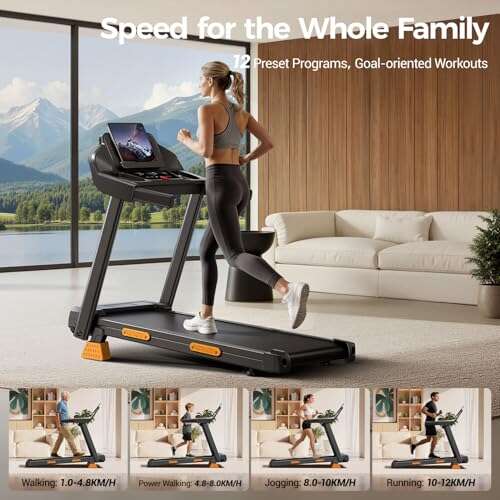
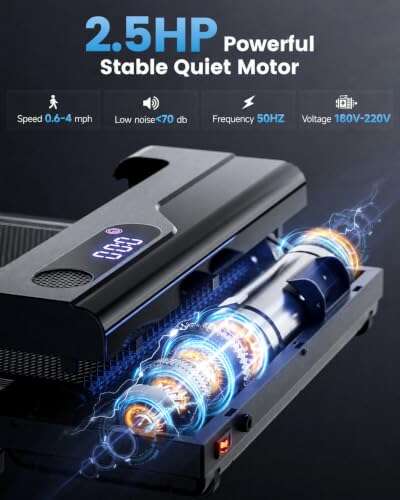
The FOUSAE is the most feature-focused treadmill in this review. It offers a 5-in-1 foldable design, a top speed of 7.5 MPH, app compatibility, a 10% incline, a 3.0 HP brushless drive, a remote, and 12 HIIT programs. Its listed 400-pound capacity also makes it one of the most substantial options here. These features make it closer to a compact training treadmill than a basic walking pad.
The larger feature set may suit an apartment user who wants one machine for walking, jogging, and structured workouts. The foldable frame helps, but this model may still be heavier and larger than a flat pad. App support can add motivation, while preset HIIT programs can reduce the need to plan each session. I would choose it only after measuring doorways, ceiling space, and the exact area where the treadmill will run.
Pros:
- 5-in-1 design supports several workout styles
- 7.5 MPH top speed allows light running
- 10% incline adds useful training intensity
- 3.0 HP brushless drive is built for regular use
- 400-pound listed capacity supports a wide user range
- App compatibility and 12 HIIT programs add variety
- Folding frame helps reduce storage demands
Cons:
- Larger and heavier than a simple walking pad
- May be too much machine for casual walkers
- Needs careful setup in a very small apartment
My Recommendation
After comparing these models, I would match the treadmill to the way you actually plan to exercise. A flat walking pad is the best choice when storage, low weight, and quiet daily steps matter most. A folding model with a handlebar is better when you want extra balance and occasional jogging. Incline models suit users who want stronger cardio without needing high running speeds.
For most apartment owners, the best compact treadmill for apartment use is the FOUSAE 5-in-1 if the room and budget can handle its larger feature set. It offers the broadest workout range, the highest listed speed in this group, app support, incline, and a strong listed capacity. For basic walking, the first flat walking pad is easier to store and may be the smarter buy. For a balance of challenge and space savings, the 18% incline model is the most ambitious option.
| Best for | Why |
|---|---|
| Smallest storage space | The flat walking pad has a slim shape and works well for under-bed or under-desk storage. |
| Most complete workouts | The FOUSAE offers several modes, a 7.5 MPH speed, 10% incline, app support, and HIIT programs. |
| Hard incline walking | The 18% incline treadmill gives experienced walkers a stronger hill-style workout in a folding design. |
How I Choose a Compact Treadmill for an Apartment
Buying the best compact treadmill for apartment use is not only about finding the smallest product. A tiny treadmill that shakes, feels unsafe, or cannot fit your stride will become an expensive coat rack. I look at the full use case: where the treadmill will sit, how often it will run, who will use it, and where it will go after the workout. The right choice should make exercise easy, not create a new problem.
Measure the machine and the room
Start with a tape measure. Check the treadmill’s length, width, and height when open. Then check the folded height if the model folds. Measure doorways, closets, bed clearance, and the path from storage to the workout area. Apartment furniture often creates tighter turns than the room itself.
Leave open space around the deck. You should not place the rear of the treadmill against a wall with no room to step off. A clear path also helps if you need to stop quickly. Never rely on a product photo to judge size.
Think about your neighbors
Noise is a major concern in apartment living. Motor hum is only one part of the sound. Foot strikes, deck vibration, and incline movement can travel through a hard floor. A thick treadmill mat can help protect the floor and soften vibration, though it cannot make a loud machine silent.
Walking creates less noise than running. If you live above another unit, use a lower speed and keep your steps soft. Avoid late-night workouts until you understand how much sound the treadmill makes in your building. A quiet treadmill is a kind neighbor, but smart use matters just as much.
Choose a deck that fits your stride
Compact treadmills save room by using shorter decks. That can work well for slow walking, but tall users may need more space. If you take long steps, a short belt can make you feel rushed. It may also force you to watch your feet instead of looking ahead.
For light walking, a small deck may feel fine. For jogging, choose the longest and widest deck your room can safely hold. Keep your arms relaxed and stay near the center. A compact treadmill should feel like a clear path, not a narrow bridge.
Decide whether you need a handlebar
Handlebars add support and can make mounting easier. They may help new users feel safer, especially when an incline is active. An adjustable handlebar offers even better fit for homes with multiple users. However, handles add height and often make under-bed storage impossible.
A handle-free walking pad is often best for under-desk use. It has fewer parts and usually slides into storage more easily. If you plan to walk at higher speeds or use incline, a handlebar may be worth the extra space. Match the bar to your balance needs, not just the product look.
Understand incline claims
Incline can make walking more demanding without a fast belt speed. It can also help add variety to a short workout. Still, a high incline changes the machine’s footprint and may increase sound. It can also require more effort from your legs, so start at a low setting.
Automatic incline is convenient because you can change the grade from a control. Manual incline may cost less and have fewer moving parts. Neither option replaces good form. Hold the bar lightly, keep your body tall, and stop if you feel pain.
Check the weight capacity carefully
A listed weight capacity is an important safety detail. I suggest choosing a model with a comfortable margin above the user’s body weight. This gives the motor and frame less stress during normal use. It can also help the treadmill feel more stable.
Do not confuse weight capacity with running quality. A high capacity does not always mean a long running deck or strong cushioning. Look at the full design. Capacity, belt size, motor details, and frame stability all matter.
Consider storage and moving weight
A treadmill can be compact and still be hard to move. A folding model may save floor space but weigh more than a flat walking pad. If you live in a walk-up apartment, think about stairs before ordering. Wheels help, but they do not remove the need to lift or guide the machine.
Store the treadmill in a dry place. Do not block vents or place objects on the belt. Keep the remote where you can find it. A simple storage habit protects the machine and makes you more likely to use it.
Apartment Treadmill Safety and Setup Tips
Set the treadmill on a firm, level floor. A soft rug may cause unwanted movement unless the manufacturer allows it. Use a proper mat on wood, tile, or laminate. The mat can reduce scratches and help catch small drops of belt lubricant.
Before each workout, check that the belt moves freely. Keep cords away from walking paths. Tie back loose clothing and keep pets and children away from the moving deck. Never step onto a moving belt at full speed.
Start at the lowest pace. Test the stop control and remote before a long session. If the treadmill has a safety key, attach it as directed. Keep one hand near the handle when you first test an incline.
Do not use an under-desk treadmill as a reason to ignore posture. Walk tall and keep your screen at a comfortable height. If you type while walking, use a slow pace. Stop if you feel dizzy, weak, or unsteady.
Maintenance Tips for Long-Term Value
Small treadmills still need care. Wipe dust from the frame and belt area. Dust can collect near the motor and affect performance over time. Follow the manual for belt lubrication, since too much lubricant can cause slipping.
Check belt alignment from time to time. A belt that drifts to one side may rub the deck or make extra noise. Make small adjustments only as the manual explains. If you hear a new grinding or clicking sound, stop using the treadmill and inspect it.
Do not overload a compact machine with long, hard sessions if it is designed mainly for walking. Let the motor cool after demanding workouts. Use the correct outlet and avoid an overloaded power strip. These simple habits can improve safety and extend the machine’s useful life.
Who Should Buy a Compact Apartment Treadmill?
A compact treadmill is a good fit for people who want convenient movement at home. It helps office workers break up long sitting time. It helps parents exercise while a child rests nearby. It also gives apartment residents an indoor option when heat, rain, snow, or poor air quality keeps them inside.
It is not always the right tool for serious runners. A full-size treadmill normally provides a longer belt, stronger structure, and more space for fast training. If you plan to run hard every day, shop for a running treadmill instead. If your goal is walking, light jogging, or steady cardio, a compact model can be a smart use of space.
FAQs Of best compact treadmill for apartment
What is the best compact treadmill for apartment use?
The best choice depends on your space and workout plan. The FOUSAE 5-in-1 is the most versatile option in this review. A flat walking pad is better if storage and simple walking matter most.
Are compact treadmills quiet enough for apartments?
Many compact treadmills are quieter during walking than running. Sound still depends on the floor, shoes, belt, and user weight. A treadmill mat and daytime workouts can help reduce neighbor concerns.
Can I place a walking pad under a desk?
Yes, a flat walking pad is usually the easiest type to use under a desk. Keep the speed low and make sure the desk leaves enough room for natural posture. Do not walk while distracted if you feel unstable.
Do I need an incline on an apartment treadmill?
No. A flat treadmill is enough for daily steps and light cardio. An incline is useful if you want more challenge without running, but it can add height, noise, and storage needs.
How much room should I leave around a compact treadmill?
Leave clear space at the front and rear so you can step off safely. Follow the manufacturer’s clearance instructions first. Also keep the sides free from cords, furniture, and pets.
Final Verdict: Which Should You Buy?
The FOUSAE 5-in-1 is my top pick for the best compact treadmill for apartment homes that need speed, incline, programs, and flexible training. Choose the flat walking pad instead if easy storage and quiet daily steps matter more.
Measure first, use a floor mat, and match the belt to your stride. The right compact treadmill can turn a small apartment corner into a steady path toward better fitness.

Brandon Knoxley is a sport & fitness writer and training guide contributor at MySportFitHub. He focuses on practical workouts, performance-based training, and honest fitness gear insights designed for real people and real results. Brandon is passionate about helping beginners and active individuals train smarter, avoid common mistakes, and build sustainable fitness habits.