How To Jog On A Treadmill: Beginner Tips For Better Runs
To jog on a treadmill, warm up, set a steady pace, keep good form, and increase effort slowly.
Learning how to jog on a treadmill is simple, but doing it well takes more than pressing “Start.” The belt changes how you move, while speed, incline, posture, and footwear all affect comfort and safety. This guide explains how to jog on a treadmill with clear steps, practical tips, common mistakes, and training ideas for beginners and regular runners.
What Is Treadmill Jogging?
Treadmill jogging is a form of steady running performed on a moving belt. It lets you control your speed, incline, workout time, and surroundings. Unlike outdoor jogging, you do not need to deal with traffic, uneven ground, bad weather, or hills that appear without warning.
For most people, jogging means moving faster than a walk but slower than a hard run. A typical jogging speed may fall between 4 and 6 mph, but there is no perfect number. Your fitness level, leg length, and comfort matter more than the number on the screen.
The best way to judge your pace is the talk test. You should be able to speak in short sentences without gasping. If you can sing with ease, the pace may be too light for a jogging workout. If you cannot say a few words, slow down.
Treadmill jogging can support:
• Cardiovascular fitness
• Better walking and running endurance
• Calorie use and weight management
• Stronger leg and hip muscles
• Indoor training during extreme heat, cold, or rain
• A controlled return to exercise after a break
A treadmill is a tool, not a test of toughness. The goal is to train at a pace you can repeat with good form.

How to Jog on a Treadmill: Step-by-Step
The safest approach is to treat each workout as a gradual build. Do not start at your target speed while your muscles are cold.
1. Check the treadmill before you begin
Stand beside the treadmill and inspect the belt, side rails, emergency stop clip, and display. Make sure the machine sits on a stable surface and has enough space around it.
Wear supportive athletic shoes with a secure fit. Tie the laces firmly, but do not make them so tight that your feet feel numb. Keep water nearby, and remove loose clothing that could catch on the belt.
Clip the safety key to your shirt if your treadmill has one. It can stop the belt if you fall or move too far back.
2. Start with a walking warm-up
Step onto the side rails before starting the belt. Turn the machine on, then begin at a slow walking speed. Hold the handrails only while you get positioned.
Walk for 5 to 10 minutes. Start near 2 to 3 mph, then add a little speed as your body warms up. Use this time to check your feet, posture, breathing, and comfort.
A warm-up raises body temperature and prepares your joints and muscles for faster movement. It also gives you time to notice pain before it becomes a larger problem.
3. Increase the speed in small steps
Once you feel warm, increase the speed by 0.1 to 0.3 mph at a time. Wait several seconds after each change so your body can adjust.
When your walking stride becomes quick and difficult to maintain, add a little more speed. Your walk may naturally change into a light jog. Keep the pace easy at first.
If you need to hold the rails to stay balanced, the speed is likely too high. Lower it until you can move with relaxed arms and an upright body.
4. Find your natural jogging pace
Your jogging pace should feel controlled, not frantic. Your feet should land under or close to your body, and your steps should feel light.
Use these signs to check your pace:
• You can speak in short sentences.
• Your breathing is faster but controlled.
• Your shoulders stay relaxed.
• You can keep jogging for several minutes.
• You do not need to grip the handrails.
• Your stride does not become long, stiff, or noisy.
A slower jog with good form is more useful than a fast jog that causes you to bounce, lean, or lose control.
5. Set a modest incline
For your first treadmill jogging workouts, use a 0% to 1% incline. A small incline may make the effort feel more like outdoor running, but it is not required.
Do not assume that a 1% incline is best for every workout. Research on treadmill and outdoor running suggests that the difference depends on speed, incline, wind, surface, and the runner. Your main goal is to choose a setting that feels smooth and manageable.
If you increase the incline, reduce the speed first. Hill work adds stress to your calves, Achilles tendons, and hamstrings.
6. Jog for short intervals
If you are new to jogging, use run-walk intervals. For example:
- Walk for 5 minutes.
- Jog for 1 minute.
- Walk for 2 minutes.
- Repeat the cycle 6 to 8 times.
- Cool down with 5 minutes of easy walking.
This method gives your heart, lungs, muscles, and joints time to adapt. Over several weeks, you can add 30 to 60 seconds to the jogging periods or shorten the walking breaks.
7. Cool down before stepping off
Lower the speed gradually instead of stopping at once. Walk for 5 to 10 minutes at an easy pace.
A cool-down helps your body shift from exercise to rest. It also gives you a chance to monitor dizziness, unusual shortness of breath, or pain.
When the belt stops, step onto the side rails first. Never jump off a moving treadmill. That habit is a common cause of slips and falls.

Proper Treadmill Jogging Form
Good treadmill form should feel quiet, balanced, and relaxed. Think of your body as a tall stack rather than a stiff board.
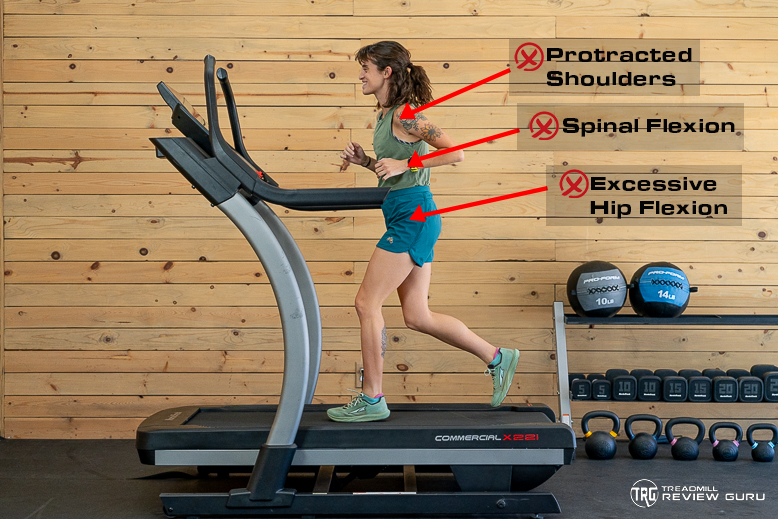
Keep your eyes forward. Looking down at your feet can make your neck bend and your posture collapse. Use the display for quick checks, then return your gaze ahead.
Let your arms swing naturally from your shoulders. Keep your elbows bent at about 90 degrees, but do not force the angle. Your hands should stay loose, as if you are holding a potato chip that you do not want to crush.
Keep your chest open and your shoulders away from your ears. Slightly lean forward from your ankles, not from your waist. Bending at the waist can reduce breathing room and place extra stress on your back.
Aim for a light landing under your body. You do not need to force a forefoot, midfoot, or heel strike. Runners naturally use different foot patterns. The main concern is avoiding a long reach that causes your foot to land far ahead of you.
Try these form cues:
• “Stand tall.”
• “Relax the hands.”
• “Keep the steps light.”
• “Look ahead.”
• “Let the arms swing.”
• “Land under the body.”
Your stride may look slightly different on a treadmill because the belt moves beneath you. That is normal. Focus on comfort and control rather than copying a runner on a video.

How Fast Should You Jog on a Treadmill?
There is no universal treadmill jogging speed. One person may jog comfortably at 4 mph, while another may need 6 mph to feel the same effort.
Use effort instead of speed as your main guide. On a scale from 1 to 10, where 1 is very easy and 10 is maximum effort, most beginner jogging should feel like a 4 to 6.
Here is a simple guide:
• Easy jog: You can talk in full sentences.
• Moderate jog: You can speak in short sentences.
• Hard jog: You can say only a few words.
• Sprint: You cannot hold a conversation.
For a first workout, try this:
• Warm up at 2 to 3 mph.
• Jog at a pace that feels like 4 to 5 out of 10.
• Continue for 1 to 3 minutes.
• Walk until your breathing settles.
• Repeat several times.
Do not chase a speed because it looks impressive. A controlled pace builds a better base and reduces the chance of soreness or injury.

Beginner Treadmill Jogging Workout
A beginner workout should be easy to repeat. Consistency matters more than one exhausting session.
Try this 25-minute plan:
- Walk slowly for 5 minutes.
- Walk briskly for 3 minutes.
- Jog for 1 minute.
- Walk for 2 minutes.
- Repeat the jog-walk cycle 5 times.
- Cool down for 5 minutes.
If one minute of jogging feels too hard, use 20 to 30 seconds. If it feels very easy, add a small amount of time instead of a large jump in speed.
Complete this workout two or three times per week. Leave at least one easier day between jogging sessions when you are new to exercise.
After two or three weeks, progress in only one way:
• Add one jogging interval.
• Add 30 seconds to each jog.
• Reduce each walking break by 15 to 30 seconds.
• Add a small amount of speed.
Changing everything at once makes it hard to know what caused soreness or fatigue. Small changes act like turning a dial rather than flipping a switch.

A Treadmill Jogging Plan for Regular Exercisers
If you already walk often and have no pain, you can use a simple three-day schedule.
Day one: Easy intervals
Jog for 2 minutes, then walk for 2 minutes. Repeat 6 to 8 times. Keep the effort moderate.
Day two: Steady jog
After a warm-up, jog continuously for 10 to 20 minutes. Use a pace that allows short sentences.
Day three: Gentle hills
Jog or walk for 2 minutes at 0% incline. Then use a 1% to 3% incline for 1 minute at a slower speed. Repeat 6 to 8 times.
Keep at least one rest or easy activity day between harder sessions. Your body improves during recovery, not only during the workout.
For general health, federal physical activity guidance encourages adults to build toward at least 150 minutes of moderate activity each week, plus muscle-strengthening work on two days. You do not need to reach that amount immediately. Start with a level you can maintain.

How to Breathe While Jogging on a Treadmill
Breathing should be steady and comfortable. Try to breathe through both your nose and mouth as your effort increases.
Some runners like a rhythm such as inhaling for three steps and exhaling for two. Others prefer a natural pattern. There is no single breathing count that works for everyone.
If you feel breathless, slow down. Do not force a deep breath while keeping a pace that is too hard.
A useful check is the talk test. If you cannot speak a short sentence, reduce the speed or add a walking break. Breathing difficulty that feels sudden, severe, or unusual requires you to stop and seek medical help.

Should You Hold the Handrails?
Avoid holding the handrails during normal treadmill jogging. Holding them can change your posture, reduce the work required from your legs, and make the speed or incline feel easier than it really is.
The rails are useful for:
• Stepping onto the treadmill
• Stepping off after the belt stops
• Regaining balance briefly
• Exercising with a medical or balance limitation
• Managing a sudden change in symptoms
If you need the rails for most of a workout, lower the speed or incline. If balance remains a concern, ask a qualified health professional for guidance before continuing.

Common Treadmill Jogging Mistakes
Even experienced runners can develop poor habits indoors. The treadmill gives instant control, so it is easy to make changes too quickly.
Starting too fast
A fast start can make the workout feel harder than expected. Begin with a warm-up and build speed in small steps.
Looking down
Watching your feet may make you lean forward and shorten your breathing. Keep your head level and look toward the front of the machine.
Taking long strides
A long stride can cause your foot to land too far in front of your body. Shorten the stride and aim for quieter steps.
Using a steep incline too soon
High inclines place extra demand on the calves and back. Use a low incline until your body is ready for more.
Ignoring the safety key
The safety key is not decoration. Clip it to your clothing and learn how it stops the belt.
Making every workout hard
Daily hard sessions can lead to fatigue and loss of motivation. Mix easy jogging, walking, rest, and strength work.
Jumping off the belt
Never jump from a moving treadmill. Slow the belt, wait for it to stop, and then step onto the side rails.
Chasing calories on the display
Treadmill calorie estimates can be inaccurate because they may not account for body composition, fitness level, handrail use, or other factors. Use the display for trends, not exact promises.
How to Make Treadmill Jogging More Comfortable
A few simple changes can make indoor jogging feel less dull and more natural.
Place a fan in front of the treadmill. Outdoor movement gives you natural airflow, while indoor exercise can feel hotter because the air is still. A fan can improve comfort and may help you maintain a steadier effort.
Choose a playlist, podcast, or show that matches the workout. Use entertainment as support, but keep enough attention on your body and the belt.
Change your focus during the session. Watch your breathing for one minute, your arm swing for another, and your effort after that. This can make the workout feel shorter without forcing you to increase speed.
Use a towel and water bottle, but place them where they cannot touch the moving belt. Keep the area around the machine clear.
If the treadmill feels too repetitive, try a light progression:
• Jog at an easy pace for 5 minutes.
• Add 0.2 mph every 3 minutes.
• Stop increasing when your effort reaches 6 out of 10.
• Hold that pace briefly.
• Reduce the speed for your cool-down.
Treadmill Jogging and Joint Safety
Treadmill jogging is often easier to control than outdoor jogging, but it still creates impact. If you have arthritis, a recent injury, chest symptoms, uncontrolled blood pressure, or a long period of inactivity, speak with a health professional before starting.
Pain is different from normal effort. Muscle warmth, mild fatigue, and heavier breathing can be normal. Sharp pain, swelling, limping, numbness, chest pressure, faintness, or severe shortness of breath are warning signs.
Stop the workout if those symptoms occur. Seek urgent medical help for chest pain, fainting, serious breathing trouble, or symptoms that do not improve with rest.
Use the following safety habits:
• Increase training time slowly.
• Wear shoes that fit well.
• Replace worn shoes when cushioning and support decline.
• Avoid jogging through sharp pain.
• Rest when fatigue changes your form.
• Keep the treadmill area dry and clear.
• Follow the machine’s weight, speed, and maintenance limits.
There is no shame in walking. A brisk walk may be the right choice on a tired day, and it still supports fitness.
How to Progress Without Overtraining
The safest progress is usually gradual. A common guideline is to avoid making large weekly jumps in time, speed, and incline. The exact amount depends on your history, age, health, and recovery.
Track a few simple details:
• Workout duration
• Jogging time
• Average effort
• Incline
• Any pain or unusual soreness
• Sleep and energy levels
If your legs feel heavy for several days, your pace feels harder than usual, or your form breaks down, reduce the workload. A lighter week can help you return stronger.
Add strength training when possible. Squats, step-ups, calf raises, bridges, and core exercises can support the muscles used in jogging. Use controlled movements and begin with a load you can manage safely.
Rest is part of the plan. Think of training as placing a small demand on the body, then giving it time to rebuild. Without recovery, even a good workout can become a poor routine.
Personal Lessons From Treadmill Training
One of the most useful lessons from treadmill sessions is that the first five minutes can be misleading. A pace may feel easy at first, then become challenging once heat and fatigue build. Starting below your maximum gives you room to finish with control.
Another common mistake is using speed to solve every problem. When a workout feels boring, some people increase the pace. A better option may be to add a short incline, change the interval pattern, or listen to something engaging.
I also see many new runners grip the rails when the belt speeds up. That habit often hides the true effort and creates tension in the shoulders. Slowing down by even 0.5 mph usually produces better movement and a more useful workout.
The most practical rule is simple: finish feeling that you could have done a little more. That mindset may seem modest, but it helps you return for the next session. Fitness grows from repeated, manageable work.
Frequently Asked Questions About How to Jog on a Treadmill
How long should a beginner jog on a treadmill?
A beginner can start with one-minute jogging intervals mixed with two-minute walking breaks. Aim for 20 to 30 minutes total, including a warm-up and cool-down.
What speed is considered jogging on a treadmill?
Jogging often falls between 4 and 6 mph, but the correct speed depends on your fitness and stride. Use a pace that allows controlled movement and short conversation.
Is jogging on a treadmill good for weight loss?
Treadmill jogging can help increase daily energy use and support weight loss when combined with suitable eating habits. Results depend on total activity, food intake, sleep, health, and consistency.
Should I use an incline when jogging on a treadmill?
You can begin at 0% to 1% incline and add more only when the effort feels manageable. A higher incline increases the demand on your calves, hamstrings, and heart, so lower the speed as needed.
Is it safe to jog on a treadmill every day?
Some people can exercise daily, but new joggers usually benefit from rest or easy walking between jogging sessions. Pain, unusual fatigue, and worsening form are signs to reduce frequency.
How can I stop feeling out of breath while jogging?
Slow the treadmill, use walk breaks, and build your jogging time gradually. If breathlessness is severe, sudden, or linked with chest pain or dizziness, stop and seek medical care.
Should I hold the treadmill rails while jogging?
Try not to hold the rails during normal jogging because they can change your posture and reduce the workout’s true difficulty. Use them briefly for balance or when stepping on and off the machine.
Conclusion
Learning how to jog on a treadmill starts with a warm-up, a manageable pace, relaxed form, and gradual progress. Keep your eyes forward, avoid gripping the rails, use short run-walk intervals, and slow down when your breathing or posture becomes difficult.
A treadmill workout does not need to be extreme to be effective. Begin with a pace you can repeat, track how you feel, and add time or speed in small steps. Start your next session with a five-minute walk, then practice one easy jogging interval at a time. Share your progress or explore more beginner fitness guides to keep building your routine.

Brandon Knoxley is a sport & fitness writer and training guide contributor at MySportFitHub. He focuses on practical workouts, performance-based training, and honest fitness gear insights designed for real people and real results. Brandon is passionate about helping beginners and active individuals train smarter, avoid common mistakes, and build sustainable fitness habits.