Does Holding On To The Treadmill: Safe Or Not?
Holding on to a treadmill lowers the workout’s challenge and may reduce balance, posture, and calorie benefits.
Does holding on to the treadmill make walking or running safer? Sometimes, yes. But for most people, gripping the front or side rails changes how the body moves and can make the workout less effective. This guide explains when holding on is helpful, when it may be harmful, and how to stop relying on the rails with confidence.
What Does Holding On to the Treadmill Mean?
Holding on to the treadmill means using the front bar or side handrails while the belt moves. People often do this when the speed or incline feels too hard, when they feel unsteady, or when they are new to treadmill exercise.
The habit seems harmless. After all, the rails are there for support. Yet your hands can quietly take work away from your legs, hips, core, and heart. It is similar to climbing stairs while pulling yourself up with the banister. You still climb, but your lower body does less of the job.
Does holding on to the treadmill always mean you are exercising incorrectly? No. Handrails can provide useful support in certain cases. The key is to use them for safety, not to carry your body through the workout.

Is Holding the Treadmill Bad for You?
Holding the treadmill is not automatically bad. It depends on why you are holding on, how tightly you grip the rails, and how much weight you place on your arms.
Lightly touching the side rails for balance is very different from leaning back and pulling yourself forward. A light touch can help you feel secure. A strong grip can change your posture and reduce the effort required from your legs.
Does holding on to the treadmill become a problem when you depend on it for the full session? Often, yes. It may:
• Reduce the natural movement of your arms
• Shorten your stride
• Shift your weight backward
• Reduce the work done by your leg muscles
• Make a steep incline feel easier than it truly is
• Hide poor speed or incline choices
• Increase stress on your wrists, shoulders, and lower back
The rails should act like a safety tool, not a substitute for balance, strength, or proper treadmill settings.

Why Do People Hold On to the Treadmill?
Most people hold on for a clear reason. They may feel tired, nervous, dizzy, or unsure about their footing. Understanding the cause helps you choose a safer solution.
The incline feels too steep
A high incline can make your calves and thighs burn fast. Some people respond by grabbing the front bar and leaning backward. This lowers the demand on the legs and changes the angle of the body.
The speed is too fast
If the belt moves faster than your natural walking pace, you may reach for the rails. This is a sign to lower the speed. Holding on does not fix the problem. It only helps you manage a setting that may be too difficult.
Balance is limited
Older adults, beginners, and people recovering from injury may need support. Some medical conditions can also affect balance. In these cases, holding the treadmill may be appropriate while a health professional guides the exercise plan.
Fear or lack of confidence
A moving belt can feel strange at first. You may worry about falling or missing your step. This is common, and it usually improves with practice, slower speeds, and better treadmill habits.
Fatigue
When your muscles tire, your form may weaken. Holding the rails can feel like an easy fix. A better choice is to slow down, reduce the incline, or take a short rest.
Does holding on to the treadmill because of fatigue mean you should stop exercising? Not always. It may simply mean your current workout is too demanding for your present fitness level.

How Holding the Rails Changes Your Form
Good treadmill form should look close to natural walking or running outside. Your head stays tall, your eyes look ahead, your shoulders remain relaxed, and your arms swing freely.
When you grip the rails, several changes can occur:
• Your shoulders may rise toward your ears.
• Your elbows may lock or bend awkwardly.
• Your body may lean backward.
• Your hips may move away from the belt.
• Your feet may land too far in front of you.
• Your steps may become short and stiff.
• Your arms may carry part of your body weight.
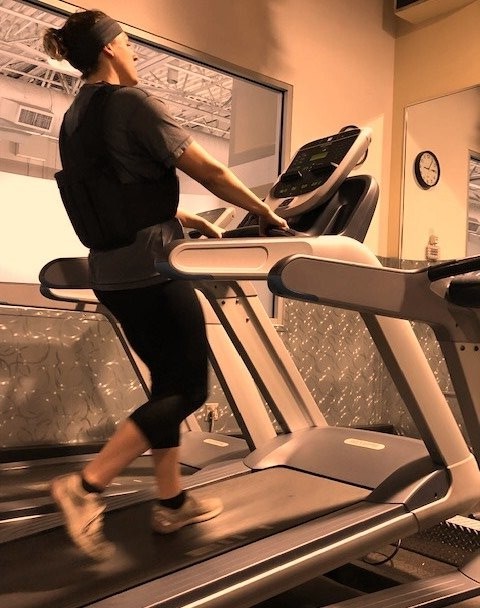
This matters because the treadmill belt moves under you. If you lean back while holding the front bar, the belt can pull your feet forward while your upper body stays behind. That position is not the same as walking naturally on level ground.
Does holding on to the treadmill affect posture? Yes. The heavier your grip, the more likely you are to use a posture that does not match normal walking or running.
Does Holding On to the Treadmill Burn Fewer Calories?
It can. The exact difference depends on your speed, incline, body weight, grip strength, and how much weight you place on the rails.
A treadmill calorie display is only an estimate. It may not know whether you are holding the rails or walking freely. When you support yourself with your arms, your legs and core usually do less work. This can lower your true energy use compared with the same speed and incline without support.
The effect may be small when you only touch the side rails. It can be much larger when you lean heavily on the front bar. Research and exercise testing have found that holding handrails during incline walking can reduce the exercise demand and make the displayed workload less accurate.
This does not mean you need to chase a calorie number. Better goals include:
• Walking with stable posture
• Using a speed you can control
• Building regular exercise habits
• Improving strength and endurance
• Finishing the session without pain or fear
Does holding on to the treadmill cancel all health benefits? No. You may still gain cardiovascular and muscular benefits. However, the workout may be less challenging than the treadmill setting suggests.

Does Holding On to the Treadmill Reduce the Workout’s Benefits?
Holding on may reduce some benefits, but it does not make every treadmill session useless. Even a supported walk can help you move more, raise your heart rate, and build exercise confidence.
The main concern is the difference between the machine setting and your actual effort. A treadmill set at a steep incline may look intense. If you hold the front bar and support much of your weight, the real challenge may be closer to a lower incline.
Possible limitations include:
Less lower-body work
Your glutes, hamstrings, calves, and quadriceps may not work as hard when your arms support your weight.
Less core involvement
Natural walking requires your trunk muscles to control rotation and balance. A firm grip can reduce this demand.
Poorer balance practice
Balance improves through controlled practice. If you always hold on, your body gets less practice managing the moving belt.
Less realistic movement
Outdoor walking does not usually involve pulling your body along with a rail. Training with heavy support may not transfer well to everyday movement.
Greater risk of poor mechanics
Leaning, twisting, or gripping hard may place extra strain on the wrists, shoulders, and lower back.
Does holding on to the treadmill still have a place in a workout? Yes. It can support safe movement during a warm-up, cool-down, balance-limited session, or carefully supervised rehabilitation plan.

When Is Holding on to the Treadmill Appropriate?
There are times when holding the rails is a smart choice. Safety always comes before workout intensity.
Use the handrails when:
• You step onto or off the treadmill
• You feel dizzy, faint, or unusually weak
• You lose your balance
• You are learning how to use a new treadmill
• You have a health condition that affects balance
• You are recovering from surgery or an injury
• A physical therapist or medical professional recommends support
• You need brief help while changing speed or incline
If you have chest pain, severe shortness of breath, confusion, or sudden weakness, stop exercising and seek medical help. Do not use the rails to push through serious symptoms.
People with heart disease, major balance problems, joint injuries, or neurological conditions should ask a qualified health professional for individual advice. General treadmill tips cannot replace a personal medical assessment.

When Should You Stop Holding the Rails?
You can work toward hands-free walking when you can maintain control at a slower setting. Do not rush this step. Confidence grows through small wins.
Try this simple progression:
-
Start at a slow walking speed.
-
Stand tall and look forward.
-
Keep your hands close to the rails without gripping them.
-
Walk for 20 to 30 seconds without support.
-
Hold the rails again if you feel unstable.
-
Repeat several times during the session.
-
Add small amounts of time as your balance improves.
When this feels easy, increase either the time or the speed. Do not raise both at once. If your form breaks down, return to the last setting you could control.
Does holding on to the treadmill during a difficult interval mean you failed? No. It means the interval was too hard for your current ability. Adjust the workout instead of forcing poor form.

How to Walk on a Treadmill Without Holding On
The goal is not to look perfect. The goal is to move in a relaxed and controlled way.
Use these form cues:
• Keep your eyes forward, not fixed on your feet.
• Stand tall with your ribs stacked over your hips.
• Relax your shoulders and hands.
• Let your arms swing naturally.
• Take short, quiet steps.
• Keep your feet under your body.
• Use a speed that lets you speak in short sentences.
• Stay near the center of the belt.
Start with the speed you can manage outdoors. For many beginners, that may be a comfortable pace between about 2 and 3 miles per hour. Your ideal speed may be higher or lower. The right setting is the one that allows control without rail support.
A useful test is the talk test. Moderate exercise usually allows you to talk but not sing comfortably. If you cannot speak a few words without gasping, lower the speed or incline.
How to Use Incline Without Gripping the Rails
Incline walking can be an excellent way to challenge the legs and heart. The problem begins when the incline is so high that you must hang on.
If you want a harder workout, try one change at a time:
• Raise the incline slightly.
• Walk for a longer period.
• Add short intervals.
• Increase speed by a small amount.
• Reduce rest time.
Keep your body upright as the incline rises. Avoid leaning far back or pulling on the front bar. If you cannot keep your hands free, lower the incline until your posture returns to normal.
Does holding on to the treadmill at a high incline make the workout safer? It may help prevent an immediate loss of balance, but it does not make the movement ideal. A lower incline without support is often a better training choice.
Common Mistakes to Avoid
Small treadmill mistakes can affect comfort and results. Watch for these common habits.
Setting the incline too high
A steep incline can cause you to grip the rails and shorten your stride. Build gradually instead.
Using the rails to step onto a moving belt
Hold the rails while the belt is stopped. Step on first, then start the treadmill at a slow speed.
Looking down the whole time
Looking at your feet can make your head and upper body bend forward. Keep your gaze ahead and use the display only for short checks.
Chasing the calorie display
Calories shown on a treadmill are estimates. Treat them as rough information, not a perfect measurement of your workout.
Ignoring pain
Muscle effort is normal. Sharp pain, joint pain, chest pain, and unusual dizziness are not signs to push through.
Trying to copy another person’s speed
Fitness levels vary. Your safest pace may look slow beside someone else’s. Consistency matters more than comparison.
A lesson trainers often see is simple: the best treadmill setting is not the most impressive number. It is the setting you can use with good control and steady breathing.
A Safe Treadmill Workout for Beginners
This simple plan can help you reduce rail use while building endurance.
Week 1
• Warm up for 5 minutes at an easy pace.
• Walk for 10 minutes at a speed that feels steady.
• Use the rails only for balance or machine adjustments.
• Cool down for 5 minutes.
Week 2
• Warm up for 5 minutes.
• Walk for 15 to 20 minutes without holding when possible.
• Add two gentle one-minute increases in speed.
• Return to an easy pace after each increase.
• Cool down for 5 minutes.
Week 3 and beyond
• Warm up for 5 minutes.
• Walk for 20 to 30 minutes.
• Add small incline changes if you can keep your hands free.
• Keep one or two easy days between harder sessions.
This plan is only a starting point. Beginners, older adults, and people with medical concerns may need a slower progression. The Centers for Disease Control and Prevention recommends regular aerobic activity, but the amount and intensity should match your health and fitness level.
Does holding on to the treadmill during this plan mean you need to go back to the start? No. Use support when needed, then return to the last level that felt safe.
What Trainers and Research Suggest
Exercise professionals generally agree that treadmill handrails should support safety, not replace proper form. The American College of Sports Medicine emphasizes controlled posture, gradual progression, and exercise intensity that matches the person’s ability.
Studies of incline treadmill walking show that handrail use can change body position and lower the work required from the legs. Research also suggests that holding rails may affect the accuracy of exercise intensity and calorie estimates.
Still, research has limits. People differ in age, fitness, walking skill, body size, and medical history. A study performed on healthy adults may not apply to someone recovering from a stroke, living with arthritis, or managing dizziness.
The most trustworthy approach is practical:
• Choose a manageable setting.
• Keep your body upright.
• Use support when safety requires it.
• Progress slowly.
• Ask a professional for help when symptoms or medical conditions are involved.
Personal Lessons From Treadmill Training
One lesson that stands out in treadmill coaching is that people often choose settings that are too hard, then blame themselves for needing the rails. In many cases, the solution is not more willpower. It is a lower speed, a lower incline, or a shorter session.
A common mistake is to set a steep incline because it appears to promise faster results. The person then leans back, grips the bar, and finishes exhausted. A better session may use half the incline, no rail support, and five more minutes of steady walking.
I also find that people gain confidence when they practice short hands-free blocks. Thirty controlled seconds can teach more than ten minutes of tense gripping. Think of it as learning to ride a bike: balance improves through calm practice, not through forcing speed.
Does holding on to the treadmill during early training make you less fit? No. It simply shows that your body is still learning the task. Treat each session as practice, not a test of your worth.
Frequently Asked Questions About Does Holding On to the Treadmill
Does holding on to the treadmill reduce weight loss?
It can reduce the energy used compared with walking at the same speed and incline without support. The effect varies, but heavy rail use may make the treadmill’s calorie estimate less accurate.
Is it okay to hold the treadmill while walking uphill?
It is okay when you need support for safety. However, if you must lean back or pull hard on the rails, lower the incline or speed until you can walk with better posture.
Can holding the treadmill cause injury?
Heavy gripping may contribute to poor posture and strain in the wrists, shoulders, or lower back. Using the rails briefly for balance is usually less concerning than leaning your body weight on them for a long time.
How can I stop holding on to the treadmill?
Lower the speed or incline, then practice short hands-free periods. Keep your gaze forward, relax your shoulders, and increase the time slowly as your balance improves.
Should older adults hold on to the treadmill?
Older adults may use the rails when balance is limited or when stepping on and off the machine. A physical therapist or qualified trainer can help choose a safe speed, incline, and progression.
Does holding on to the treadmill affect posture?
Yes, especially when you grip tightly or lean backward. Rail use can limit arm swing and shift your body away from the natural walking position.
Is holding the side rail better than holding the front rail?
A light touch on the side rail is often less disruptive than pulling on the front rail. Neither should carry much of your body weight during normal walking.
Conclusion
Holding the treadmill is sometimes useful, but heavy dependence can reduce the challenge and change your walking form. The safest approach is to choose a speed and incline you can manage with a tall posture, relaxed arms, and steady steps.
Use the rails for balance, machine adjustments, and medical needs. When possible, lower the intensity and practice short hands-free intervals. Start today with a setting that feels controlled, then build gradually as your confidence grows. Share your treadmill experience or explore more exercise guides to keep improving safely.

Brandon Knoxley is a sport & fitness writer and training guide contributor at MySportFitHub. He focuses on practical workouts, performance-based training, and honest fitness gear insights designed for real people and real results. Brandon is passionate about helping beginners and active individuals train smarter, avoid common mistakes, and build sustainable fitness habits.