How To Move A Treadmill Upstairs: Safe Moving Guide
Move a treadmill upstairs by securing the deck, using three or more adults, and lifting with a stair-rated appliance dolly.
Learning how to move a treadmill upstairs takes more than muscle. A treadmill is heavy, wide, and awkward, while stairs leave little room for error. This guide explains the safest method, from measuring the route and preparing the machine to carrying it up the stairs and setting it up again.
Is It Safe to Move a Treadmill Upstairs?
Moving a treadmill upstairs can be safe when you plan the job and use the right equipment. Many home treadmills weigh between 200 and 400 pounds, and commercial models may weigh much more. Their weight is often uneven, with the motor near the front and the running deck extending behind it.
The main risks are:
• Back, shoulder, and hand injuries
• A treadmill slipping down the stairs
• Damage to walls, floors, railings, or the machine
• Pinched fingers under the frame
• Electrical damage from a bent cord or crushed console cable
Do not attempt this job alone. Even a folding treadmill may be too heavy for one person to control on stairs. If the treadmill is very large, the stairs are narrow, or the route has sharp turns, hiring professional movers is the safer choice.

Check the Treadmill and Stairway First
Before learning how to move a treadmill upstairs, inspect both the machine and the route. This simple check can prevent a difficult lift from becoming an emergency.
Read the Owner’s Manual
Look for the treadmill’s shipping weight, moving instructions, and approved lifting points. Some treadmills have transport wheels and locking pins. Others have fragile side rails or console arms that should never be used as handles.
The owner’s manual may also explain how to fold the walking deck. If you cannot find the manual, search for the model number on the manufacturer’s website. Do not guess where to lift.
Measure Everything
Measure the following areas:
• Treadmill width, height, and length
• Stair width between walls or handrails
• Ceiling height above the stairs
• Doorway width at the start and end points
• Landing size and turning space
Add a few inches of clearance to each measurement. A treadmill may fit through a doorway when flat but fail at the angle needed to turn onto a staircase.
Inspect the Stairs
Check the condition of every step. Loose boards, weak railings, wet surfaces, and clutter can create serious hazards. Clear pets, children, rugs, boxes, and furniture from the full route.
If the stairs have open risers, glass panels, or a sharp spiral turn, stop and assess the risk carefully. These features make it harder to keep the treadmill balanced.
Gather the Right Moving Equipment
Good equipment reduces the amount of force your team must use. It also gives you better control, which matters more than raw strength when moving a treadmill upstairs.
Use these items when possible:
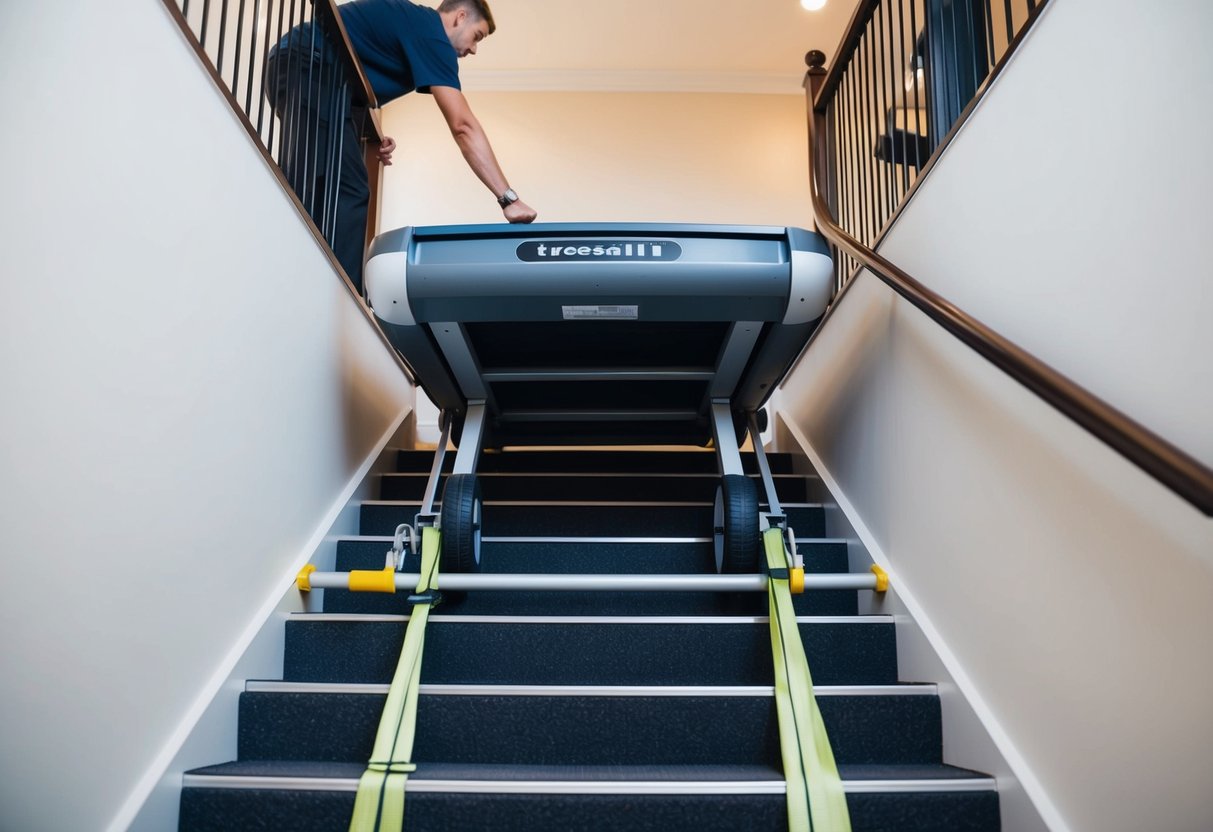
• Appliance dolly with stair-climbing straps
• Four or more heavy-duty moving straps
• Furniture blankets
• Stretch wrap or strong packing tape
• Work gloves with rubber grip
• Closed-toe, slip-resistant shoes
• Measuring tape
• Screwdriver or hex key set
• Flashlight
• Plywood or floor protection
A standard two-wheel hand truck is not always suitable for stairs. An appliance dolly has wider wheels, stronger straps, and a design made for tall, heavy items. Some professional models use a powered track system for stairs.
Avoid using rope as the main support. Rope can slide, cut into the treadmill frame, or fail without warning. A rated moving strap gives your team more control and creates a better grip.

Prepare the Treadmill for Moving
Preparation is the most important part of how to move a treadmill upstairs. A few minutes spent removing loose parts can make the machine lighter and less awkward.
Follow these steps:
-
Unplug the treadmill and remove the power cord from the wall.
-
Let the motor and belt cool if the treadmill was recently used.
-
Remove the safety key and store it in a labeled bag.
-
Remove the cup holders, tablet holder, fan parts, weights, and other loose accessories.
-
Fold the running deck if the model supports safe folding.
-
Lock the deck in place using the manufacturer’s locking mechanism.
-
Remove the console or handrails only if the manual allows it.
-
Tape or strap loose cables against the frame without crushing them.
-
Wrap the console, side rails, and motor cover with furniture blankets.
-
Secure the blankets with stretch wrap, not adhesive tape directly on painted surfaces.
Never lift a treadmill by its console, display, handrails, or motor cover. These parts may look strong, but they are not always designed to carry the full weight of the machine.

Build a Safe Moving Team
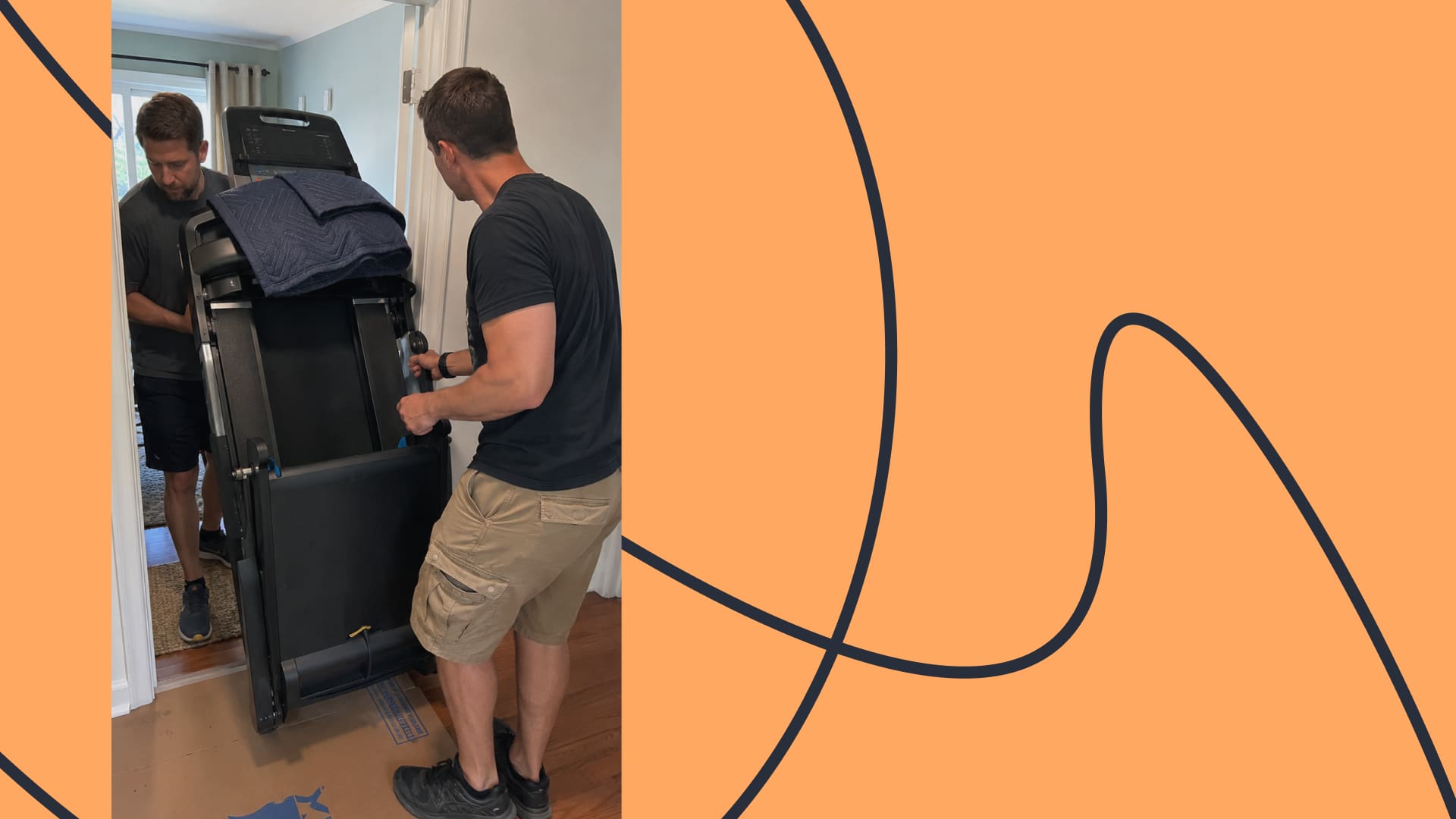
For most treadmills, use at least three strong adults. Four people may be better for a large commercial treadmill or a long staircase.
Assign clear roles before lifting:
• Lead person: stands higher on the stairs and guides the direction.
• Lower lifters: control the heavier motor end from below.
• Side guide: watches for walls, railings, cables, and hand placement.
The person at the lower end often faces the greatest risk because gravity pulls the treadmill downhill. That person should not work alone or stand directly below an unsecured machine.
Use simple commands such as “lift,” “hold,” “step,” “stop,” and “lower.” Only one person should give commands. Agree that anyone can call “stop” if the load shifts or a person loses balance.
A useful lesson from heavy appliance moves is that communication beats speed. Most accidents happen when someone moves before the rest of the team is ready.

How to Move a Treadmill Upstairs With a Dolly
An appliance dolly is usually the safest manual method when the staircase can accommodate it. The following process works for many folding and nonfolding treadmills, but the manufacturer’s instructions always come first.
Position the Dolly
Place the dolly at the treadmill’s heavier end, usually the front near the motor. Keep the dolly upright and close to the frame. Do not place its metal plate against a thin plastic cover.
Use furniture blankets between the dolly and treadmill. This protects the frame and helps prevent sliding.
Strap the Treadmill Securely
Wrap two or more straps around the treadmill frame and dolly. Place the straps around strong structural areas, such as the main steel frame. Keep straps away from the belt, drive motor, cables, and delicate plastic parts.
Tighten the straps until the treadmill cannot move independently from the dolly. Test the connection with a gentle push before approaching the stairs.
Tilt and Test
With one person stabilizing the far end, slowly tilt the treadmill onto the dolly. Keep the load close to the dolly wheels. If the treadmill feels top-heavy, lower it and adjust the straps.
Practice tilting it on a flat surface first. This reveals balance problems before you are on the stairs.
Move Up One Step at a Time
Face the dolly toward the stairs if the dolly manufacturer permits stair use. The higher team member should pull or guide from above, while the lower team members push and stabilize from below.
Move one step at a time:
-
Confirm that everyone is ready.
-
Lift or pull the dolly onto the next step.
-
Pause and let the team regain balance.
-
Check that straps remain tight.
-
Repeat only after the lead person gives the command.
Never rush, bounce, or drag the treadmill up the stairs. If the load shifts, stop and lower it to a stable position before adjusting the straps.
How to Move a Treadmill Upstairs Without a Dolly
Moving a treadmill upstairs without a dolly is possible in limited cases, but it carries more risk. Use this method only when the treadmill is light, the stairs are wide, and enough trained adults are available.
A strong lifting strap system can help distribute the weight. Place straps beneath the main frame, not around the walking belt or console. Keep the treadmill as level as possible and lift from the frame with bent knees.
The strongest person should not automatically take the heaviest position. Each person must be able to hold the load without twisting or stepping backward blindly.
Use these safety rules:
• Keep hands away from pinch points.
• Do not carry the treadmill above shoulder height.
• Do not stand directly below it on the stairs.
• Keep the load close to your body.
• Take frequent pauses on landings.
• Never attempt the move if someone feels tired, dizzy, or unstable.
For a heavy treadmill, a dolly or professional moving service is strongly preferred. The cost of equipment or help is usually much lower than the cost of a damaged treadmill or serious injury.

How to Move a Treadmill Around a Corner or Landing
Landings are often harder than straight stairs because the team must turn the treadmill while holding its weight. Measure the landing before starting, and decide which end will turn first.
At a landing, stop with the treadmill fully supported. Do not turn while the dolly is balanced on a single stair edge. One person should guide the upper end around the corner while the others slowly pivot the lower end.
Protect the walls with moving blankets. Remove a handrail only when necessary and only if it can be safely reinstalled. Do not force the treadmill through a tight turn, since this can damage the frame or trap a team member.
If the landing is too small, consider an alternate route. In some homes, moving the treadmill through a larger window or using professional stair equipment may be safer than forcing a turn.

How to Protect Floors, Walls, and the Treadmill
A treadmill can damage flooring even when it does not fall. Its wheels may leave marks, and the frame can scrape walls during a turn.
Protect the route with:
• Furniture blankets on walls and door frames
• Plywood sheets over delicate floors
• Cardboard under the dolly wheels
• Corner guards on sharp edges
• Stretch wrap around loose parts
Do not put smooth plastic sheeting on stairs. It can make shoes and dolly wheels slide. Use materials that protect the surface without reducing traction.
Keep the treadmill upright only when the manual allows it. Some models should remain flat or at a specific angle during transport. When in doubt, follow the manufacturer’s instructions instead of relying on general moving advice.
Common Mistakes to Avoid
Knowing what not to do is a key part of how to move a treadmill upstairs safely. These mistakes are common because the treadmill may appear easier to handle than it really is.
Moving It Alone
One person may be able to roll a treadmill across a room, but stairs are different. The load can shift suddenly, and there is no safe way to catch a falling treadmill alone.
Using Weak Lifting Points
Do not pull on the console, side rails, cup holders, or plastic motor cover. These parts may break and leave you with less control.
Skipping the Measurements
A few inches can determine whether the treadmill fits through a turn. Measure before disassembly, not after the machine is already on the stairs.
Forgetting the Power Cord
A loose power cord can catch on a step or become trapped under a wheel. Secure it to the frame and keep it away from moving parts.
Rushing the Job
Fatigue increases the chance of a dropped load. Take breaks, especially on long staircases. A slow move is a successful move.
Reassembling Without Checking Cables
After relocating the treadmill, make sure cables are connected correctly and not pinched. A damaged cable can cause console failure or create an electrical hazard.
Set Up and Test the Treadmill After Moving
Once the treadmill reaches the upper floor, place it on a level surface with enough clearance around it. Many manufacturers recommend leaving space behind and beside the machine so users can step off safely and perform maintenance.
Complete these checks before plugging it in:
-
Remove the straps and blankets.
-
Inspect the frame for cracks, bends, or loose bolts.
-
Reinstall removed parts according to the manual.
-
Check that the walking belt is centered.
-
Confirm that the power cord and console cables are undamaged.
-
Make sure the treadmill sits level and does not rock.
-
Plug it into the correct outlet.
-
Start the belt at the lowest speed.
-
Listen for rubbing, clicking, or unusual motor sounds.
-
Walk on it briefly before using a higher speed.
Do not use the treadmill if the belt slips, the frame rocks, the console behaves oddly, or you smell burning. Unplug it and contact the manufacturer or a qualified technician.
When to Hire Professional Movers
Professional help is the best option when the treadmill is unusually heavy or the route is difficult. Consider hiring movers if:
• The treadmill weighs more than your team can safely control.
• The staircase is narrow or steep.
• There is a spiral turn or small landing.
• The treadmill does not fold.
• You have a history of back, knee, or shoulder problems.
• The route includes wet steps or poor lighting.
• You lack an appliance dolly and proper straps.
Ask the moving company whether it has experience with exercise equipment and stair moves. Confirm that the service includes equipment protection and damage coverage. A professional crew can also disassemble and reassemble some treadmill models.
The goal is not to prove that you can lift a heavy object. The goal is to move it without injury or damage.
Frequently Asked Questions About How to Move a Treadmill Upstairs
Can two people move a treadmill upstairs?
Two people may move a small, lightweight folding treadmill, but many models require three or four adults for safe control. Check the machine’s weight and the stair layout before deciding.
Can I move a treadmill upstairs without taking it apart?
Sometimes. Folding the deck and removing the console or handrails may make the treadmill easier to handle, but only disassemble parts approved by the manufacturer.
What is the safest way to move a treadmill upstairs?
An appliance dolly with stair-rated straps is usually the safest manual method. Use clear commands, move one step at a time, and keep the treadmill secured to the dolly.
Should the motor end go first or last?
The motor end is usually heavier and should be carefully supported near the lower side during the climb. The exact position depends on the treadmill design, so follow the owner’s manual when it gives specific instructions.
Can I lay a treadmill on its side?
Some treadmills can be transported on their side, while others may suffer damage to the motor, belt, or frame. Check the manufacturer’s instructions before changing the treadmill’s normal transport position.
How much does it cost to have a treadmill moved upstairs?
The price depends on the treadmill’s weight, the number of stairs, location, disassembly needs, and local labor rates. Request a written estimate and ask whether stair equipment and damage coverage are included.
How long should I wait before using the treadmill after moving it?
You can usually use it after it is fully assembled and inspected. Run it at low speed first, then stop immediately if you notice unusual noise, belt movement, electrical smells, or frame instability.
Conclusion
Learning how to move a treadmill upstairs safely starts with planning, measuring, and choosing the right equipment. Secure the deck, protect the route, use an appliance dolly when possible, and involve enough adults to control the load. Never rush a stair move or lift from fragile treadmill parts.
If the route is tight or the treadmill is very heavy, professional movers are the smart choice. Use this guide to plan your move carefully, and share your own moving tips or questions in the comments.

Brandon Knoxley is a sport & fitness writer and training guide contributor at MySportFitHub. He focuses on practical workouts, performance-based training, and honest fitness gear insights designed for real people and real results. Brandon is passionate about helping beginners and active individuals train smarter, avoid common mistakes, and build sustainable fitness habits.