Does Incline Treadmill Build Muscle: Muscle-Building Facts
Yes, an incline treadmill can build some muscle, mainly in your glutes, calves, hamstrings, and thighs.
The answer to “does incline treadmill build muscle” depends on the incline, speed, workout length, and your training level. Walking uphill makes your lower-body muscles work harder than flat walking, but it usually builds strength and muscle endurance more than large muscle size. This guide explains what incline treadmill training can do, where it falls short, and how to use it safely.
Does incline treadmill build muscle?
Yes, incline treadmill workouts can build muscle, especially when the incline creates enough resistance to challenge your legs. Walking uphill forces your body to lift itself against gravity with every step. This increases the work done by your glutes, hamstrings, calves, and quadriceps.
However, incline treadmill training is not the same as heavy strength training. It can stimulate muscle growth in beginners, people returning to exercise, and anyone using a steep incline. For experienced lifters, it is better for muscle endurance, conditioning, and calorie burn than for major muscle size.
The key factor is progressive overload. Your muscles must face a gradually greater challenge over time. You can increase the incline, walking speed, workout time, or number of uphill intervals.

Which muscles does incline treadmill walking work?
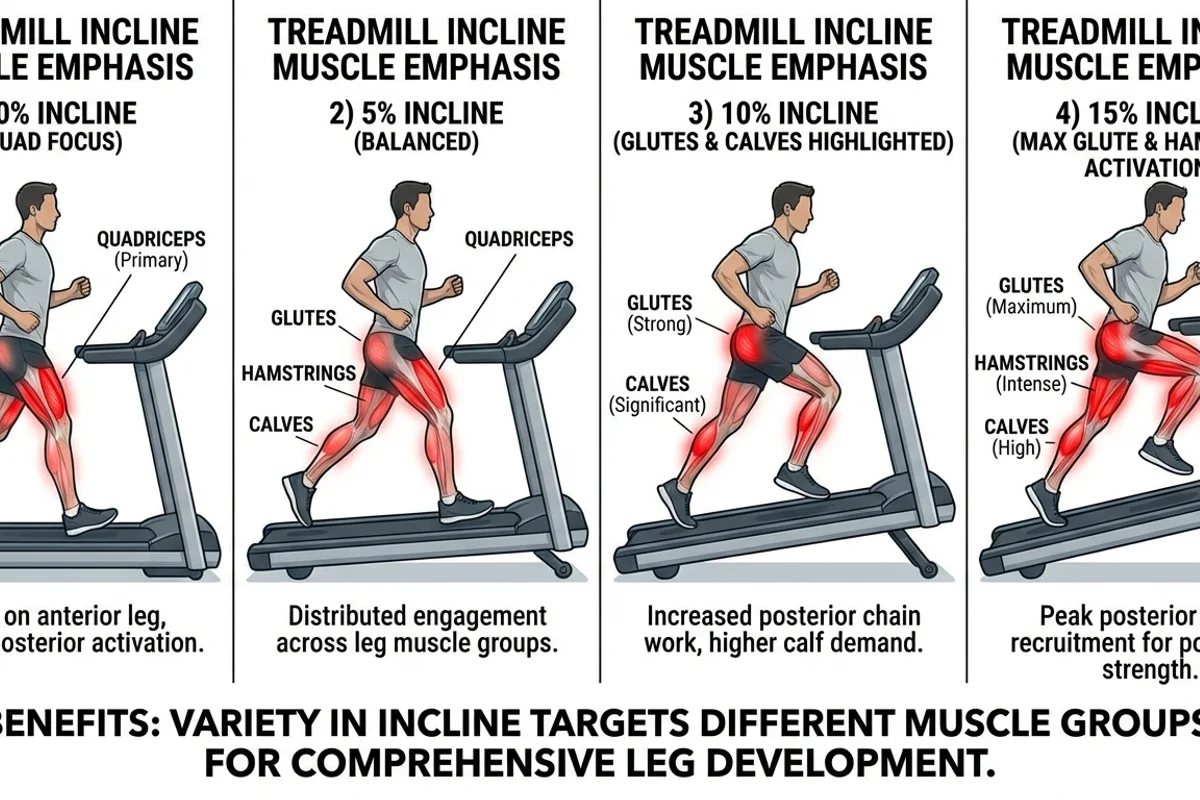
Incline walking uses many of the same lower-body muscles as flat walking, but the uphill angle increases the demand. The steeper the incline, the more force your legs need to produce.
Glutes
Your gluteus maximus helps extend your hip as you push your body upward. A steep incline can make your glutes work much harder than they do during level walking.
To feel more glute work, take steady steps and push through your whole foot. Avoid holding the front rails, since that can reduce the load on your legs.
Hamstrings
Your hamstrings help extend your hips and bend your knees. They work with your glutes to drive each step up the treadmill belt.
Incline walking does not train the hamstrings through the same full range as exercises such as Romanian deadlifts. Still, it can improve hamstring endurance and contribute to stronger legs.
Quadriceps
Your quadriceps straighten your knee and help support your body during each step. They become especially active when you walk at a faster pace or use a lower incline with more speed.
Calves
Your calf muscles help push your foot away from the belt. A higher incline often increases the amount of ankle movement and makes the calves work harder.
If your calves feel tight, lower the incline and warm up before training. Sudden increases in incline can irritate the Achilles tendon.
Core muscles
Your core helps keep your trunk stable as you walk uphill. The core demand is not as high as it is during loaded carries or squats, but good posture still requires abdominal and lower-back control.

How much muscle can an incline treadmill build?
The incline treadmill can build a modest amount of muscle, but the results vary. Beginners may notice stronger and firmer legs because their muscles are adapting to a new form of resistance. People with more training experience usually need heavier resistance to create further muscle growth.
Muscle growth depends on several factors:
• Training intensity: The workout must feel challenging by the final minutes or intervals.
• Progressive overload: You need to increase the challenge over time.
• Protein intake: Your body needs amino acids to repair and build muscle tissue.
• Total calories: Eating too little can limit recovery and muscle growth.
• Sleep and recovery: Muscles adapt between workouts, not during the workout itself.
A useful way to think about incline walking is as a bridge. It can move you from easy cardio toward stronger legs, but it may not take you all the way to significant muscle size by itself.
For noticeable hypertrophy, combine incline treadmill sessions with resistance exercises. Squats, step-ups, lunges, hip thrusts, and calf raises provide more direct and controllable resistance.
Can incline treadmill replace leg day?
For most people, no. Incline treadmill training can support leg strength, but it does not fully replace a structured lower-body workout.
Strength exercises allow you to load specific muscles and train them through a wide range of motion. They also make it easier to track resistance and apply progressive overload.
Incline walking is still valuable when:
• You are new to exercise.
• You need a low-impact training option.
• You want to improve work capacity before lifting weights.
• You are recovering from a break and need a gradual return.
• You want extra glute and calf work after strength training.
A balanced week might include two lower-body strength sessions and two incline treadmill workouts. This approach trains both muscle force and cardiovascular fitness.
Best incline treadmill settings for muscle
There is no single best incline treadmill setting for everyone. Your ideal setting depends on your fitness level, goals, balance, and joint health.
Beginner setting
Start with a 3% to 6% incline at a comfortable walking speed. Aim for 15 to 25 minutes. You should breathe harder but still speak in short sentences.
Intermediate setting
Try a 6% to 10% incline for 20 to 35 minutes. You can also use short intervals, such as two minutes uphill followed by two minutes at a lower incline.
Advanced setting
Experienced users may use a 10% to 15% incline for short periods. Keep your posture tall and avoid leaning heavily on the rails.
A simple muscle-focused treadmill session may look like this:
-
Warm up for five minutes at a 1% to 3% incline.
-
Walk for three minutes at a 6% incline.
-
Walk for two minutes at a 10% to 12% incline.
-
Repeat the work intervals four to six times.
-
Cool down for five minutes at a low incline.
The goal is not to choose the highest number on the treadmill. The goal is to create a hard but controlled effort while keeping good form.

How to use an incline treadmill for muscle growth
If you want to know does incline treadmill build muscle in practice, your programming matters more than the machine itself. A casual uphill walk may improve fitness, but a planned workout gives your muscles a stronger reason to adapt.
Use these methods to make your sessions more effective:
Increase the incline slowly
Raise the incline by 1% or 2% when your current setting feels easy. Large jumps can stress your calves, knees, hips, or lower back.
Use controlled steps
Take firm steps without bouncing or rushing. Push through your foot and keep your hips under your shoulders.
Limit rail support
Holding the rails can make the workout feel easier because your arms support part of your body weight. Use the rails only for balance or safety.
Add intervals
Short, steep intervals can increase muscle demand without forcing you to walk at a very high speed. For example, walk at 10% to 12% incline for 30 to 60 seconds, then recover at 3% to 5%.
Combine treadmill and weights
Use the treadmill as a warm-up, finisher, or separate cardio session. Pair it with exercises that target the glutes, quads, hamstrings, and calves.
Eat for recovery
If muscle gain is your goal, consume enough total food and protein. Many active adults do well with roughly 1.2 to 2.0 grams of protein per kilogram of body weight per day, depending on training and health needs. Individual needs can vary, so a registered dietitian can provide personal guidance.

Incline treadmill versus flat treadmill
Flat treadmill walking is easier to sustain for a longer time. It is useful for daily activity, recovery, and basic cardiovascular health.
Incline treadmill walking increases the workload without requiring you to run. It usually raises your heart rate and places more demand on your glutes, calves, hamstrings, and thighs.
Here is a simple comparison:
• Flat walking: Easier on the muscles and useful for long, steady sessions.
• Incline walking: More demanding for the lower body and cardiovascular system.
• Incline running: Higher impact and greater power demand.
• Stair climbing: Often more demanding per step, but it may be harder on the knees and hips.
The best choice depends on your goal. If you want low-impact cardio with extra lower-body work, incline walking is a strong option.
Incline treadmill benefits beyond muscle growth
The question does incline treadmill build muscle often comes from people who also want better fitness and body composition. Incline walking can provide several benefits beyond muscle development.
Improved cardiovascular fitness
Incline walking raises your heart rate without the impact of running. Over time, this can improve your ability to perform daily tasks and longer workouts.
Higher calorie use
Walking uphill generally requires more energy than walking on a flat surface at the same speed. Your exact calorie use depends on body weight, speed, incline, fitness level, and workout time.
Better muscular endurance
Your legs learn to keep working under steady tension. This can help with hiking, climbing stairs, sports, and long periods of standing.
Lower impact than running
Incline walking keeps one foot on the belt at most times. That usually creates less impact than jogging, although it can still stress the joints if the incline is too high.
Better training variety
Changing the incline gives you a simple way to make treadmill exercise less repetitive. Small changes can also help you stay consistent, which matters more than a perfect workout plan.
Common mistakes during incline treadmill workouts
Many people ask does incline treadmill build muscle after trying steep walking without seeing results. Often, the problem is not the treadmill. It is poor form, poor progression, or unrealistic expectations.
Holding the rails
Leaning on the rails reduces the load on your legs and can change your posture. Lower the incline if you need to hold on for support.
Leaning too far forward
A slight forward angle from the ankles is fine. Bending sharply at the waist can place extra stress on your lower back and reduce glute involvement.
Using too much speed
A fast pace can turn the workout into a balance challenge. Choose a speed that lets you take smooth steps and keep control.
Increasing everything at once
Do not raise the incline, speed, duration, and frequency in the same week. Change one variable at a time.
Skipping strength training
Incline walking can help build muscle, but it is not a complete leg program. Add resistance training if muscle size is a top goal.
Training through sharp pain
Normal muscle fatigue is common. Sharp pain in the knee, hip, ankle, or Achilles area is a reason to stop and assess the problem.
A practical weekly plan
This sample plan can help you use an incline treadmill without overtraining your legs.
Option for beginners
• Monday: 20 minutes at a 3% to 5% incline
• Wednesday: Full-body strength training
• Friday: 20 to 25 minutes using gentle incline intervals
• Weekend: Easy walking, mobility work, or rest
Option for intermediate exercisers
• Monday: Lower-body strength training
• Tuesday: 25 minutes at a 6% to 8% incline
• Thursday: Upper-body strength training
• Saturday: 30 minutes with five short steep intervals
Leave at least one easier day between hard lower-body sessions. If your legs remain sore, reduce the incline or shorten the workout.
In my experience, the most common mistake is chasing a steep incline every session. A moderate incline used consistently often produces better results than an extreme incline that causes pain or ruins the next workout.
Is incline treadmill training safe?
For most healthy adults, incline treadmill walking is safe when progressed gradually. Still, the risk of discomfort rises when you use a steep incline, hold poor posture, or train through pain.
Use these safety tips:
• Warm up for five minutes before steep walking.
• Wear stable shoes with good grip.
• Keep your eyes forward instead of looking down.
• Use the safety clip when appropriate.
• Keep one hand near the rails when stepping onto or off the belt.
• Reduce the incline if you feel knee, hip, calf, or Achilles pain.
• Speak with a health professional if you have heart disease, severe joint pain, balance problems, or a medical condition that affects exercise.
Research and exercise guidelines consistently support gradual progression, proper technique, and recovery. Even a simple walking plan can become too demanding when intensity rises too quickly.
How to combine incline walking with strength training
The best answer to does incline treadmill build muscle is often a combination plan. Use incline walking to add conditioning and muscular endurance, then use weights for focused muscle growth.
A lower-body workout could include:
-
Squats or leg presses for the quadriceps and glutes.
-
Romanian deadlifts for the hamstrings and glutes.
-
Walking lunges or step-ups for single-leg strength.
-
Hip thrusts for the glutes.
-
Calf raises for the lower legs.
-
Incline treadmill walking for conditioning.
If you do the treadmill before lifting, keep it short and moderate so your legs are not tired before strength work. If muscle growth is your main goal, many people prefer lifting first and using the treadmill afterward.
Frequently asked questions about does incline treadmill build muscle
Does incline treadmill build glutes?
Yes, incline treadmill walking can strengthen and develop the glutes, especially in beginners. Steeper inclines and controlled steps increase glute demand, but heavy hip thrusts, squats, and lunges are usually better for maximum glute growth.
Does walking uphill build leg muscle?
Walking uphill can build some leg muscle and improve muscular endurance. The effect is strongest when the incline is challenging and increased gradually over time.
Is a 12-3-30 workout good for building muscle?
The 12-3-30 workout uses a 12% incline, 3-mile-per-hour speed, and 30-minute duration. It is useful for fitness and lower-body endurance, but it may not provide enough resistance for significant muscle growth in experienced trainees.
How often should I use an incline treadmill to build muscle?
Two to four sessions per week can work well, depending on your strength training and recovery. Start with two sessions and add more only if your legs, joints, and energy levels recover well.
Should I use the treadmill before or after weights?
Use the treadmill after weights if muscle growth and strength are your main goals. A short, easy incline walk before lifting can work as a warm-up, but a hard session may reduce your lifting performance.
Can incline treadmill walking replace squats?
No, incline walking does not fully replace squats or other resistance exercises. It trains the legs through repeated steps but does not provide the same load, range of motion, or strength stimulus.
Will incline treadmill walking make my legs bulky?
It is unlikely to make your legs bulky by itself. Incline walking usually improves endurance and muscle firmness, while significant size gains require strong resistance training, enough food, and consistent progression.
Conclusion
So, does incline treadmill build muscle? Yes, it can build some muscle and improve strength endurance in the glutes, calves, hamstrings, and quadriceps. Its muscle-building effect is greatest for beginners and people who use progressive overload, but it does not replace a complete resistance-training program.
Start with a moderate incline, keep your posture tall, avoid leaning on the rails, and increase the challenge slowly. Pair incline walking with strength exercises and good recovery if you want the best results. Try a structured session this week, track your incline and time, and adjust your plan as your fitness improves.

Brandon Knoxley is a sport & fitness writer and training guide contributor at MySportFitHub. He focuses on practical workouts, performance-based training, and honest fitness gear insights designed for real people and real results. Brandon is passionate about helping beginners and active individuals train smarter, avoid common mistakes, and build sustainable fitness habits.